Skip to content

10 Lace Brassiere Buying Tips for Global Buyers

Global buyers are paying closer attention to Lace Brassiere quality, fit, and supply reliability. Grand View Research valued the global lingerie market at approximately USD 88.32 billion in 2023. It also projects steady growth through 2030, supported by e-commerce and changing consumer preferences. The opportunity is real. So are the risks.

A Lace Brassiere may look delicate on a product page, yet its performance depends on precise details. Buyers should inspect lace recovery, cup stability, underwire finishing, strap adjustability, and colorfastness. A sample should survive repeated stretching without losing shape. The sewing line must remain smooth against the skin. Small defects become expensive returns.

Sara Blakely, founder of Spanx, has said, “The most important thing is to feel good in what you’re wearing.” Her point applies directly to intimate apparel purchasing. Comfort is not a marketing extra. It is a measurable product requirement. Buyers should request test reports, size specifications, material percentages, and factory quality records before placing larger orders. OEKO-TEX® STANDARD 100 certification can also support safer textile sourcing, although certification alone does not prove perfect workmanship.

This guide presents ten practical buying tips for global buyers. It covers supplier evaluation, lace selection, construction, sizing, packaging, pricing, and delivery planning. Some recommendations may seem obvious. They are still often missed. One sample is not enough. A beautiful photograph is not proof. Real purchasing confidence comes from checking details repeatedly, and from questioning assumptions before they become costly mistakes.
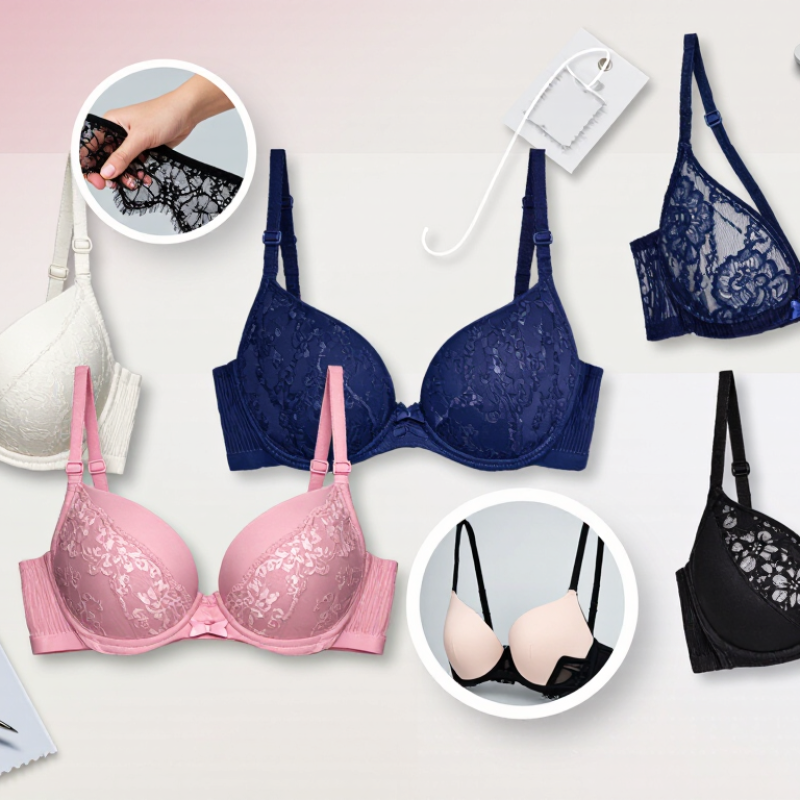
10 Lace Brassiere Buying Tips for Global Buyers

Understanding Lace Brassiere Types and Construction

Lace brassieres differ sharply in appearance, stretch, durability, and production cost. Raschel lace uses machine-made patterns and offers consistent supply for larger orders. Leavers lace has finer detail and a softer hand, but usually requires tighter quality control. Stretch lace commonly combines nylon or polyester with elastane, helping the garment follow body movement. According to Grand View Research, the global lingerie market was valued at about USD 91.11 billion in 2023, with growth projected through 2030. That expansion increases demand for attractive, scalable construction.

Global buyers should inspect more than the lace surface. Check fiber percentages, recovery after stretching, cup lining, cradle stability, and elastic width. A well-built brassiere often combines lace with power mesh, molded foam, or a supportive inner frame. Underwire channels should feel smooth, without exposed stitching or sharp ends. The International Trade Centre highlights textiles as a major traded product group, but trade data does not measure comfort or construction quality. That limitation matters.

Ask suppliers for dimensional tolerance, colorfastness, wash testing, and needle-damage inspection records. Compare samples after repeated washing, not only when they arrive. A beautiful lace edge can curl after one cycle. That is easy to miss. European sizing and Asian sizing may also differ, so approve measurements with a graded specification sheet. One practical warning: higher lace density does not automatically mean better support. Construction balance matters more than decoration. Procurement teams should record test conditions, because “stretch recovery” without a defined method remains difficult to compare.

Evaluating Materials, Craftsmanship, and Comfort

Global buyers should evaluate a lace brassiere beyond its appearance. Check the fiber label, lace density, lining, and elastic recovery. Cotton blends can improve softness, while polyamide and elastane often support durability and stretch. Textile Exchange’s Materials Market Report 2024 states that global fiber production reached 124 million tonnes in 2023. Material efficiency matters.

Inspect the inside carefully. Smooth seams should not scratch the skin. The underwire must sit flat without pressing the breast tissue. Straps need firm adjustment, not stiff edges. Test the back closure repeatedly. It should close securely and remain comfortable after movement. Hold the lace against light. Uneven holes, loose threads, or weak embroidery suggest poor craftsmanship. Small details matter.

Comfort also requires practical testing. Ask suppliers for wash-cycle samples, dimensional measurements, colorfastness results, and fiber certificates. Measure stretch before and after washing. A waistband that loses recovery quickly can ruin a well-made design. Fit models with different body shapes, because one sample cannot represent every customer. This is where buyers often misjudge. UNEP reports that the textile industry generates about 92 million tonnes of waste annually, so longer wear deserves serious attention. Do not rely only on attractive photography. Evaluate breathability, moisture handling, and skin feel during several hours of wear. Then record every defect, even minor ones.

10 Lace Brassiere Buying Tips for Global Buyers - Evaluating Materials, Craftsmanship, and Comfort

No. Buying Dimension Recommended Benchmark What to Check Buyer Action Priority
1 Fiber Composition Use lace with a durable fiber blend, commonly nylon or polyester combined with elastane for stretch and recovery. Review the fiber-content label and confirm whether the elastic components are separately identified. Request a material specification sheet and verify that the composition matches the approved sample. High
2 Lace Quality and Coverage The lace should have an even pattern, stable net structure, and sufficient opacity for the intended market. Inspect the fabric against light for holes, uneven motifs, broken threads, skipped stitches, or visibly thin areas. Approve a fabric swatch before sampling and define acceptable limits for pattern variation and defects. High
3 Stretch and Recovery The lace and band should stretch enough for movement and return close to their original dimensions after use. Measure the sample before and after repeated stretching; look for permanent distortion, rippling, or loose edges. Compare samples after several stretch-and-release cycles and record dimensional changes in the inspection report. High
4 Cup and Band Fit The center front should lie flat, the cups should contain the bust without gaping, and the band should sit level. Conduct fittings across the target size range using a standardized fit model or mannequin. Test at least one core size and the adjacent size range before confirming the production pattern. High
5 Strap and Adjuster Function Straps should adjust smoothly, remain secure, and provide adequate support without cutting into the shoulders. Check adjuster movement, strap width, attachment strength, and whether hardware creates pressure points. Perform repeated adjustment and pull tests on samples, especially for extended-size products. Medium
6 Seams and Edge Finishing Seams should be flat and secure, while neckline and underarm edges should not fray or create excessive bulk. Inspect stitch density, seam alignment, thread tails, bar-tacks, elastic joins, and folded or bound edges. Set a written workmanship standard and use random final inspections for each production lot. High
7 Skin Comfort The garment should feel smooth during extended wear, with soft lining and elastic that does not cause excessive pressure. Check the reverse side for rough lace points, exposed seams, abrasive labels, and stiff or uncovered elastic. Carry out a wear trial lasting several hours and collect feedback from users with different body shapes. High
8 Colorfastness and Care Color should remain stable under the care method stated on the label, and trims should not bleed onto adjacent materials. Review care instructions and test color transfer, washing, perspiration, and light exposure as appropriate for the market. Request test evidence or conduct independent testing before placing a large order. Medium
9 Size Grading and Measurement Each size should follow a consistent measurement chart, with grading that maintains support and proportions across sizes. Measure band, cup depth, strap placement, center height, and underwire or side-support dimensions against the approved specification. Use a tolerance sheet and approve a pre-production sample for every important size group. High
10 Compliance and Packaging Labels, fiber information, care instructions, country-of-origin details, and packaging should meet the destination-market requirements. Check labeling language, safety information, packaging cleanliness, carton strength, and documentation required for import. Confirm destination-country rules with a qualified compliance specialist before shipment. High

Note: Benchmarks should be finalized through approved samples, destination-market regulations, and the buyer’s written product specification.

Selecting Sizes for Diverse International Markets

10 Lace Brassiere Buying Tips for Global Buyers

Selecting Sizes for Diverse International Markets

Global buyers should treat brassiere sizing as a measurement issue, not a letter conversion. ISO 8559-1 supports consistent body-measurement practices for apparel sizing. Measure the underbust firmly, the fullest bust area, and the shoulder position. Record centimeters and inches. Do not rely on a customer’s usual size alone. Cup volume can change when the band changes. This detail is often missed.

Use ten practical checks: separate body measurements from garment measurements; identify each market’s band system; confirm cup labeling rules; test sister sizes; measure lace stretch; inspect wire length; check strap adjustment; review closure settings; photograph fit on varied bodies; and document return reasons. A 2023 NRF and Appriss Retail report estimated $743 billion in U.S. retail returns, equal to 14.5% of retail sales. Poor fit is not the only cause, but unclear size guidance increases avoidable returns.

Regional charts need local validation. A 75C label may not equal the same fit everywhere. Ask suppliers for graded measurements, not only size names. Request samples in smaller, average, and fuller bust proportions. Check the center gore against the chest, especially under thin lace. The band should stay level after movement. It should not ride upward.

Our first size chart might look precise, yet still fail across real bodies. That is worth admitting. Fit-test with diverse volunteers before a large order. Keep feedback by market, age range, and body shape. Update the chart when evidence changes, using ISO measurement language and supplier records.

10 Lace Brassiere Buying Tips for Global Buyers: Selecting Sizes for Diverse International Markets

This chart shows commonly used equivalent band labels across UK/US and EU sizing systems. The EU band number is based on nominal underbust circumference in centimetres; actual fit can vary by measurement method, garment construction, and local size charts.

  1. Measure the underbust snugly while standing naturally.
  2. Measure the bust at the fullest point without compressing the tissue.
  3. Use the target market’s size chart instead of converting by label alone.
  4. Check whether the seller uses UK, US, EU, or another regional system.
  5. Remember that cup letters may change between international systems.
  6. Consider sister sizes when the band or cup fit is slightly incorrect.
  7. For lace styles, inspect stretch recovery because lace can relax with wear.
  8. Review return, exchange, and hygiene policies before placing bulk orders.
  9. Request a sample or size set when purchasing for a new market.
  10. Validate fit on the intended customer group before final production.

Checking Quality Standards, Certifications, and Packaging

10 Lace Brassiere Buying Tips for Global Buyers

Quality checks should start with the fabric, not the product photograph. Request fiber composition, colorfastness, dimensional stability, and seam-strength test reports from an independent laboratory. Textile Exchange reported that global fiber production reached 124 million tonnes in 2023, making traceable material selection increasingly important. For lace brassieres, inspect cup edges, underwire channels, hook alignment, and elastic recovery after repeated stretching. Small flaws become costly returns.

Ask suppliers which certifications cover the finished product, not merely the raw fabric. OEKO-TEX STANDARD 100 can verify harmful-substance testing, while GOTS applies only when organic fibers and processing requirements are met. ISO 9001 supports documented quality procedures, but it does not prove chemical safety. Check certificate numbers, issuing bodies, validity dates, and scope. A logo alone proves little. I once treated a valid-looking certificate as sufficient; that was careless.

Packaging needs equal scrutiny. Confirm carton strength, moisture protection, inner-bag material, labeling accuracy, and barcode readability through a pre-shipment inspection. The Textile Exchange report also highlights the pressure to reduce virgin-material dependence across the fiber system. Request recycled-content evidence when claims are made, and verify whether packaging components are actually recyclable in the destination market. Use carton drop tests and compression tests for long-distance shipments. Keep packaging minimal, but do not sacrifice hygiene. A thinner polybag may reduce waste, yet it can expose delicate lace to dust and abrasion.

Comparing Suppliers, Costs, Shipping, and Order Terms

Tip: Compare suppliers beyond the catalog price. Lace brassieres need stable stretch recovery, clean seams, and consistent cup shaping. Request a pre-production sample, fabric composition, colorfastness results, and recent quality records. The World Bank’s 2023 Logistics Performance Index evaluates customs, infrastructure, shipment reliability, and tracking. These factors can reveal why a cheaper supplier may deliver slowly or inconsistently. A low quote can still be wrong.

Tip: Build a landed-cost sheet before negotiating. Include unit price, sampling fees, packaging, inspection, duties, insurance, and inland transport. The International Trade Centre’s trade data tools help buyers compare import values and tariff conditions by market. Ask for prices at several quantities, such as 500, 2,000, and 5,000 pieces. Material waste may change the real cost. Do not trust one spreadsheet too quickly.

Tip: Shipping and order terms deserve equal attention. The UNCTAD Review of Maritime Transport 2024 highlights continuing exposure to route disruption, freight volatility, and schedule uncertainty. Compare air, sea, and consolidated freight using cost per unit and delivery risk. Define the Incoterm, shipment window, carton measurements, inspection stage, and remedy for defects. Payment terms should match production milestones, not only the supplier’s preference. A practical structure might use deposits, inspection approval, and balance payment. Still, every market and supplier carries different risks. Recheck the assumptions before signing.